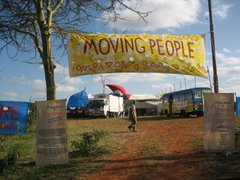
Call for Contributions:
Interdisciplinary Workshop Series “Major Concepts in Tourism Research”
March to May 2008
Leeds/ UK
Much research in the field of tourism addresses at least one of the following concepts: Exchange, Memory, Representation and Experience. Although these concepts are very popular, it is not at all obvious what they actually refer to, and how we may be able to grasp them in our research.
Therefore, the PhD-students at the Centre for Tourism and Cultural Change at Leeds Metropolitan University are organizing four workshops. Each of these workshops will extend over two days during which we will discuss intensively one of the concepts. The discussions will be based to a large extent on the contributions of the participants. Thus, we invite PhD-students from all disciplines to present short papers. PhD-students may also contribute ideas and critiques of articles, which we will distribute before the workshops. The contributions do not have to be polished conference papers but can be presentations of ideas related to the particular workshop theme. The papers will be circulated among the other participants 10 days before the respective workshop to promote lively and engaged discussion. People can also attend without presenting any formal contribution.
Furthermore, we have invited an expert on the specific topic for each workshop to give an introductory keynote and lead the discussions. On the basis of their introductions we will explore meanings and different approaches to the concepts. This constitutes a unique opportunity for PhD-students to get feedback on their reflections and work in progress by leading academics and other PhD-students, sharing and developing ideas in relation to the four themes addressed.
Cost: £20.00 for one workshop. You can also register for all four workshops for £60.00.
Please register for one single workshop or the whole series not later than 17 February 2008 by either sending an abstract of about 200 words or stating by how you intend to relate to the topic of the workshop.
Please note that the deadline for submission of the papers and contributions for the first workshop is 29 February 2008. E-Mail: C.Mueller@leedsmet.ac.uk
Timetable of the Workshop-Series
13/14 March 2008 Workshop “Experience”
Keynote: Claudio Minca, University of London
“After the Island: the hard work of being (with) tourists”
3/4 April 2008 Workshop “Exchange”
Keynote: Keith Hart, Goldsmith College London
"On commoditization: exchange in the human economy"
17/18 April 2008 Workshop “Memory”
Keynote: Sharon MacDonald, Manchester University
“Memory, Materiality and Tourism”
8/9 May 2008 Workshop “Representation”
Keynote: David Crouch, University of Derby
“The Problems with Representation: Consumption, Space and Images”
Tuesday, 5 February 2008

Sunday, 6 January 2008
Tourism as the last Utopia?
In an interview with the e-zine atopia, antropologist Marc Auge has agured that tourism might be the last Utopia. He explains:
Tourism is used here, as it is frequently and by no way without sense, as a metaphor of modernism while the tourist becomes an expression, an examplification of modern man. Modernism is conceived as a condition in which the individual identity looses its authentic and genuine reference to one place. The tourist, that is the modern person, is able to imagine the whole of the planet as places of transistion, places to play, in which no attachment of any seriousness is needed anymore, no foundation in a given culture or identity.
The problem with this view is of course, that it doesn't understands the dialectic of attachment and play, or of necessity and freedom to use the concepts of Hannah Arendt. While the modern man is understanding himself as being homeless and uprooted, the promise of freedom that this situation seems to entail is seriously hampered by his own constant fear, that - really - this apparent freedom is an illusion. Auge's postulation of a tourist utopia has often been described by authors both in literature and in theory. For Adorno as much as for Guy Debord, the fun and spectacle of a modern society of tourists was the place of a dystopian horror of the same uncanny qualities as Huxley's brave new world: Drugged into consent by the cultural industries, human beings lost their capacity to critically reflect their condition and lost their freedom altogether.
Hannah Arendt has convincingly argued (in the human condition) that modernity is marked by a loss of understanding about the relation of necessity and freedom. The conditionality of human life is linked to its transcendence and therefore man cannot be free without an understanding of her conditions because freedom means nothing but the repeated transcendence of conditions and necessity. While modern man might feel free and uprooted, he really has lost the understanding and capacity to see the conditions that govern her life. This makes modern politics at the same time inherently utopian (a free society seems near) and paranoid (as a conspiracy is always threatening to spoil the promise).
The utopian value that Auge argues for is nothing new, but remains firmly in the realm of modern thinking and concepts. Naively he repeats that it would be nice, if everybody was at play with their identity and cultures. The modern play he rightly observed is at place not only in the tourist encounters with locaties but in as much in the invention of tradition, the construction of imagined communities and the extinction of the ones we identify as conspiring against us. The modern play is dead serious. In as much our capacity to understand where we are actually located in this world is limited, we should be rather sceptical about the utopian promise of our apparent homelessness.
Despite appearances, the everyday world already knows some utopias. Tourism is one of these. The tourist is the one who is able to imagine the whole of the planet as places of transition. This utopia can be judged in two different ways. Either one considers that this is the final stage of the consumer society, you are sold movement, displacement, with some sun or sand to boot. Individuals buy their capacity to move and one is therefore at the limit of the system. According to the utopian perspective, the individual who moves around, who is unattached or, more precisely, who plays with attachments, free to choose these bonds, seems to me to have a highly commendable value. Quite the opposite of solitude then, a freedom of choice that no longer roots itself in identity, a given culture.Auge is well known and has been critized a lot for his notion of non-places, in which he described airports and shopping malls to be lacking of a distinct local quality. In his discussion here of tourism as utopian he repeats a fallacy that often governs the thinking of modernism from the perspective of a "post".
Tourism is used here, as it is frequently and by no way without sense, as a metaphor of modernism while the tourist becomes an expression, an examplification of modern man. Modernism is conceived as a condition in which the individual identity looses its authentic and genuine reference to one place. The tourist, that is the modern person, is able to imagine the whole of the planet as places of transistion, places to play, in which no attachment of any seriousness is needed anymore, no foundation in a given culture or identity.
The problem with this view is of course, that it doesn't understands the dialectic of attachment and play, or of necessity and freedom to use the concepts of Hannah Arendt. While the modern man is understanding himself as being homeless and uprooted, the promise of freedom that this situation seems to entail is seriously hampered by his own constant fear, that - really - this apparent freedom is an illusion. Auge's postulation of a tourist utopia has often been described by authors both in literature and in theory. For Adorno as much as for Guy Debord, the fun and spectacle of a modern society of tourists was the place of a dystopian horror of the same uncanny qualities as Huxley's brave new world: Drugged into consent by the cultural industries, human beings lost their capacity to critically reflect their condition and lost their freedom altogether.
Hannah Arendt has convincingly argued (in the human condition) that modernity is marked by a loss of understanding about the relation of necessity and freedom. The conditionality of human life is linked to its transcendence and therefore man cannot be free without an understanding of her conditions because freedom means nothing but the repeated transcendence of conditions and necessity. While modern man might feel free and uprooted, he really has lost the understanding and capacity to see the conditions that govern her life. This makes modern politics at the same time inherently utopian (a free society seems near) and paranoid (as a conspiracy is always threatening to spoil the promise).
The utopian value that Auge argues for is nothing new, but remains firmly in the realm of modern thinking and concepts. Naively he repeats that it would be nice, if everybody was at play with their identity and cultures. The modern play he rightly observed is at place not only in the tourist encounters with locaties but in as much in the invention of tradition, the construction of imagined communities and the extinction of the ones we identify as conspiring against us. The modern play is dead serious. In as much our capacity to understand where we are actually located in this world is limited, we should be rather sceptical about the utopian promise of our apparent homelessness.
Saturday, 13 October 2007
China's Online Travel Industry

The China Web2.0 Review blog recently covered several new Chinese travel sites, comparing them to some of the more popular US travel sites.
Comparing Some New Chinese Travel Websites
The author of that blog post concludes that "Overall, None of these websites seems really impressive. They are still far behind Ctrip on user base. I think adding more innovative ideas like personalized travel plan similar to what Yahoo Travel and TripHub did may help them gaining ground in the online traveling market."
I have an article in this month's (Oct 2007) issue of the Far Eastern Economic Review. Unfortunately, my article (titled "China's Growing Wanderlust"), cannot be seen without a paid subscription. One of the topics that I cover in that article is the state of online travel in China. A few points that I make are:
- Although online travel bookings in China grew 72 percent in 2006 to over 2.75 million bookings, valued at 1.54 billion yuan (US$204 million), it pales in comparison to the US, where the online travel market generated revenues of US$83 billion in 2006.
- Chinese consumers have been wary of both online transactions and the use of credit cards (both on- and off-line).
- Chinese travel agents discourage online bookings because they pay higher credit card fees online (1.0%) compared to in person (0.1%). So the approach to online travel in China is to direct the public to call centers for information and bookings, and to travel agency offices for cash transaction.
- Successful online travel agencies in China negotiate special travel packages at favorable prices that are attractive to the middle and upper classes, who are also more willing to use credit cards and pay a little more for the convenience of online travel bookings.
- The biggest online travel agency, by far, in China is Ctrip.com, which accounted for 54.2% of online sales in 2006, followed by eLong.com with 17.8 percent of the market. Expedia.com owns 52 percent of eLong.com, but also has its own China website this year.
(This blog entry was originally posted on my Web 2.0 Travel blog. - Alan)
Subscribe to:
Posts (Atom)